
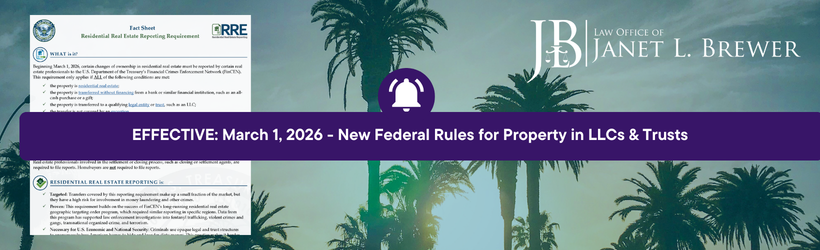
New FinCEN Residential Real Estate Reporting Rules take effect March 1, 2026. Learn how they may affect property held in LLCs and trusts, and what estate planning clients should know.
If you own residential real estate through an LLC, partnership, or trust, there’s an important new federal regulation you should know about. Beginning March 1, 2026, the U.S. Treasury’s Financial Crimes Enforcement Network (FinCEN) is implementing new Residential Real Estate Reporting Rules that could create new reporting obligations for certain property transfers.
According to the Financial Crimes Enforcement Network, the new rule requires certain residential real estate transfers involving legal entities or trusts to be reported to help combat money laundering. More details are available on the official FinCEN page: https://www.fincen.gov/residential-real-estate-rule
Here’s what you need to understand.
What Is the FinCEN Residential Real Estate Rule?
The new rule, issued under the Bank Secrecy Act (not the Corporate Transparency Act, which is a separate regulation), requires certain real estate professionals involved in closings and settlements to file “Real Estate Reports” with FinCEN. The goal is to combat money laundering in the residential real estate market, particularly through all-cash transactions that can obscure who actually owns a property.
The rule was originally set to take effect December 1, 2025, but FinCEN postponed the compliance date to give industry professionals more time to prepare. That extension expires on March 1, 2026.
When Does the Rule Apply?
A real estate transfer triggers reporting requirements only when ALL of the following conditions are met:
- The property is residential real estate — generally defined as property designed for occupancy by one to four families, including single-family homes, condos, co-ops, townhouses, and certain vacant land intended for residential construction. Larger apartment buildings (5+ units) and most commercial properties are excluded.
- The transfer is non-financed — meaning it does not involve a mortgage or institutional loan from a regulated lender. This includes all-cash purchases, gifts, seller-financed deals, and private loans.
- The property is transferred to a legal entity or trust — such as an LLC, corporation, partnership, or trust. Transfers directly to individuals are not covered.
- No exception applies — FinCEN has carved out several important exceptions (discussed below).
Good News for Many Estate Planning Clients
FinCEN has built in exceptions that are particularly relevant to estate planning:
- Transfers resulting from death: This includes transfers pursuant to the terms of a will or trust, operation of law, or transfer-on-death deeds. So if a loved one passes away and their real estate needs to be retitled from the decedent’s trust into an irrevocable trust for beneficiaries, that transfer is generally exempt.
- Individual-to-own-trust transfers: When an individual (alone or with their spouse) transfers property for no consideration into a trust where they are the settlor/grantor, the transfer is generally exempt. This covers the standard estate planning “funding deed” — the type of transfer that occurs when you create a revocable living trust and deed your home into it.
- Other exceptions: Transfers resulting from divorce, court orders, and bankruptcy proceedings are also excepted.
Situations That May NOT Be Exempt
Even in an estate planning context, some transfers can fall outside the easy exemptions:
- Gifts to someone else’s trust: If a parent deeds a house to a child’s trust, this may not fit the “individual-to-own-trust” exemption.
- Trust-to-trust restructuring: The no-consideration exemption specifically requires the transferor to be an individual, not a trust. So deeding property from one trust to another trust may not qualify.
- Transfers involving LLCs: Property held in or transferred to an LLC is squarely within the scope of the rule, and the estate planning carveouts may not apply.
Who Has to File the Report?
Importantly, the reporting obligation falls on real estate professionals involved in the closing or settlement process — not on the property owner or buyer directly. FinCEN uses a “reporting cascade” that primarily places responsibility on settlement agents and title companies, though attorneys who record deeds could be pulled into the cascade in certain situations.
Reports must be filed through FinCEN’s BSA E-Filing System by the later of 30 calendar days after closing or the last day of the month following the closing.
What Should You Do?
If you own residential real property through an LLC or other entity structure, or if you are planning property transfers that might not fall within the exemptions, I recommend consulting with a FinCEN compliance professional to understand your obligations.
While FinCEN compliance is outside the scope of my estate planning practice, I can connect you with a qualified professional who can help. Contact our office at (650) 770-2116 to request a referral.
And if these new rules prompt you to think about how your real estate is currently held within your estate plan, I’m always here to help you review and optimize your planning.
For more information, visit FinCEN’s official resource page at https://www.fincen.gov/rre.
This blog post is provided for informational purposes only and does not constitute legal advice regarding FinCEN compliance. The law is complex and evolving. Please consult a qualified professional for guidance specific to your situation.