Steward — a term for someone entrusted with the care of something that does not personally belong to them — is commonly used in business, public service, and environmentalism.
Conservationists may be referred to as stewards of the land. Business leaders may describe themselves as stewards charged with acting in shareholders’ best interests. Public figures speak of stewardship of democracy, taxpayer dollars, and the public trust.
The concept has also gained traction in finance and wealth management. Adopting a stewardship mindset shifts conversations about estate planning and inheritance from consumption to long-term preservation, from entitlement to responsibility, and from instant gratification to legacy.
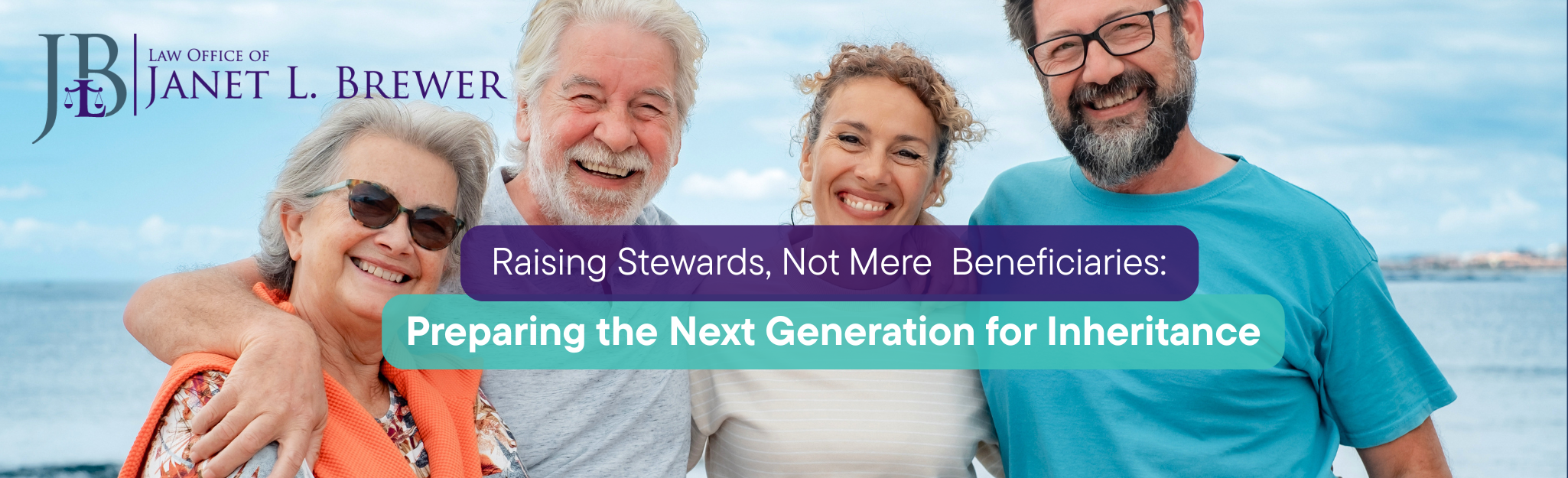
In estate planning, raising stewards rather than mere beneficiaries can reshape how families approach intergenerational wealth — and how well that wealth endures.
Americans Plan to Inherit, but Do They Intend to Be Stewards?
Many Americans expect an inheritance. Between one in five and one in four are counting on it, according to Northwestern Mutual, and most say that an inheritance is central to their financial security.
When asked how they would use an inheritance, the top responses included putting the money into savings (nearly 75 percent), investing it (57 percent), purchasing or improving a home (40 percent), and paying off debt (39 percent). Rounding out the top five, respondents said they plan to pass their inheritance forward to their own children — a goal shared by roughly one-third of those surveyed, including 39 percent of Gen Z.
Yet this desire to leave a financial legacy does not always align with the steps required to preserve one. Almost two-thirds of Gen X respondents report that they do not have a will — the most fundamental estate planning document. Estate planning intentions, in other words, often outpace estate planning actions. No family wants to see their wealth dissipate within a generation or two, but that is exactly what can happen when assets are transferred without a stewardship framework in place.
Reframing Inheritance Around Stewardship Principles
Even the most affluent families — often assumed to be well-versed in wealth preservation — can struggle to sustain it across generations. Research suggests that around three-quarters of high-net-worth families say their heirs are “not very prepared” for their inheritance, and 61 percent acknowledge that they have provided no meaningful direction about how they intend the wealth to be used.
That gap is rarely the result of indifference. More often, it reflects the discomfort many families feel when it comes to discussing money directly — particularly across generations. Parents who worked hard to build wealth may worry that transparency will reduce their children’s drive. Others simply assume the conversation can wait, or that the estate planning documents themselves will speak for them. They rarely do.
The lesson is less about the size of the estate than it is about preparation. A well-structured trust or a carefully drafted will can transfer assets efficiently, but neither document can transfer values, context, or the sense of responsibility that makes an heir a steward rather than simply a recipient.
When handing down more modest fortunes, words like legacy can feel out of reach. But stewardship is not about magnitude — it is about mindset.
Research also suggests that the way families think and talk about money shapes the way the next generation receives it. If an inheritance is described as a windfall, it is often treated like one. If it is presented as something built with intention and meant to endure, heirs are more likely to approach it with care.
That shift does not happen on its own. It requires thoughtful, ongoing conversation. Families who speak openly about how their wealth was created, what sacrifices were made, and what values guided their decisions give heirs more than assets — they give them context. That context can foster a sense of responsibility that, over time, helps shape beneficiaries into stewards.
When families avoid these discussions, assumptions fill the gap. When they have them, alignment becomes possible. Stewardship grows in clarity, not in silence.
How to Raise a Steward: Breaking the Inheritance Silence
Many financial advisors recommend proactive family conversations about money to help prevent misunderstandings, build financial literacy, align multigenerational values, and set realistic expectations. A lack of transparency around transfers can lead to confusion and conflict that make mismanagement more likely.
That said, a single conversation is unlikely to be sufficient. Stewardship develops through ongoing engagement — think of these discussions as a continuing dialogue that incorporates the following:
- Talk openly about money and decision-making. Make financial conversations a regular part of family life. Even younger family members can begin to understand that choices involve trade-offs. As they mature, discussions can expand to include investing, tax considerations, and long-term planning. Confidence with money tends to develop gradually, not all at once.
- Involve family members in philanthropy or shared financial decisions. Experience builds judgment. Allowing the next generation to research charitable causes, participate in giving decisions, or observe meetings with advisors reinforces the idea that wealth carries responsibility — and makes that responsibility tangible.
- Consider a shared family mission statement. Identify what the family’s wealth is meant to support — whether that is education, entrepreneurship, community impact, or long-term stability. A written statement, whether formal or informal, can guide both family conversations and trust design, giving family members a shared standard to work toward.
- Start small. Responsibility develops with practice. Managing a modest account, participating in family budgeting discussions, or overseeing a limited pool of funds can reinforce sound habits well before significant assets change hands.
Putting Stewardship into Practice
For California families with substantial assets — whether built through decades in business, real estate, or careers in the technology sector — the question of how wealth transfers is often as important as how much transfers. Thoughtful estate planning can help ensure that the structures you put in place reflect the values you hope to pass on.
Stewardship does not require perfection. It requires intention. And for that intention to take root, families need to move from private reflection to open conversation — and from conversation to the planning decisions that give it meaning.
Schedule Your Right Fit Conversation
Whether you are thinking about how to structure an inheritance or how to prepare the next generation to receive it, the Janet L. Brewer team is here to help. Your Right Fit Conversation is a 30-minute getting-to-know-you meeting designed to help us understand your situation and determine whether our firm is the right fit for your needs.
Call us at (650) 325-8276 or complete our online contact form to schedule your meeting.